Car cargo volume chart
| Vehicle class | Cargo behind row 2 (seats up) | Cargo behind row 1 (all rear seats folded) | Notes |
|---|---|---|---|
| Sedan | 13 to 16 cu ft (trunk) | Trunk volume is fixed; folding rear seats opens a pass-through, not a merged floor-level space | Trunk and cabin are separated by a solid partition on most sedans |
| Hatchback | 20 to 25 cu ft | Typically 50 to 55 cu ft with seats folded | Hatch opening and flat floor make folded space more usable than a sedan's pass-through |
| Compact SUV | 30 to 38 cu ft | Typically 60 to 72 cu ft with seats folded | Most common car camping vehicle class for a family of 4 |
| Three-row SUV | 40 to 48 cu ft (behind row 2, third row up) | Typically 80 to 100 cu ft with rows 2 and 3 folded | Third row eats into cargo space when in use; fold it for camping gear |
| Minivan | 75 to 90 cu ft | Typically 140 to 165 cu ft with all rear seats folded | Largest common class; frequently fits full camp gear plus a cooler without a rooftop box |
These are typical industry ranges by vehicle class, not figures for any specific model. Always check your exact vehicle's specifications for precise numbers before assuming your car matches the class average.
Gear that matches this chart
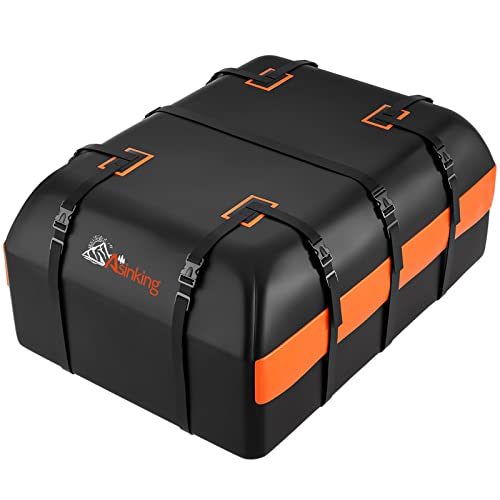


| Vehicle class | Usable behind row 2 (cu ft) | Usable behind row 1, all seats folded (cu ft) | Add a rooftop cargo box (14 to 18 cu ft) |
|---|---|---|---|
| Sedan | About 10 to 12 | Limited pass-through only | Not typically compatible without a roof rack |
| Hatchback | About 15 to 19 | About 38 to 41 | Usable total roughly 52 to 59 |
| Compact SUV | About 23 to 29 | About 45 to 54 | Usable total roughly 59 to 72 |
| Three-row SUV | About 30 to 36 | About 60 to 75 | Usable total roughly 74 to 93 |
| Minivan | About 56 to 68 | About 105 to 124 | Usable total roughly 119 to 142 |
Real packing rarely fills a vehicle to its rated volume, since gear is irregularly shaped and you need some clearance to load and unload without unpacking everything. The 75 percent figure is a practical planning number, not a hard physical limit. A rooftop cargo box typically adds 14 to 18 cu ft on top of interior cargo space.
Why does 'behind row 2' matter more than total interior volume for car camping?
Cargo behind row 2 is the space you can load and unload without disturbing passengers, which matters if you are traveling with a full car of people and still need somewhere to put a cooler, tent, and chairs. Folding the seats down to reach the larger 'behind row 1' figure works fine when driving with fewer passengers, but it is not available space if everyone in the vehicle needs a seat. Check your specific gear list against your vehicle's real cargo space with the cargo fit calculator.
Why is a sedan's trunk so much less useful than a hatchback's cargo area?
A sedan's trunk is a separate enclosed compartment behind a solid partition, so even when the rear seats fold down, you get a pass-through opening rather than one continuous flat-floor space the way a hatchback, SUV, or minivan offers. That structural difference is why sedans lag every other vehicle class badly on usable cargo volume for car camping gear, despite sometimes having a similar quoted trunk volume to a small hatchback.
Does a rooftop cargo box solve a small vehicle's space problem?
It helps meaningfully, typically adding 14 to 18 cu ft, which can be the difference between a tight fit and a comfortable one for a sedan or small hatchback. It does not solve everything though: a rooftop box is best for lightweight, weather-resistant items like sleeping bags and soft duffels, not a heavy cooler, since loading weight onto the roof affects handling and fuel economy more than interior storage does. See the shortlist at best rooftop cargo boxes.
How much gear actually fits in a compact SUV for a family of 4?
At around 23 to 29 usable cu ft behind row 2, a compact SUV typically fits a 6-person tent, a cooler in the 45 to 65 quart range, sleeping bags and pads for four, a couple of camp chairs, and a kitchen box, though it gets tight without folding a seat or adding a rooftop box for bulkier gear like a large cooler or extra chairs. This is why compact SUVs are the most common car camping vehicle class; they sit right at the edge of comfortable capacity for a typical family kit.
Keep planning
Frequently asked questions
How much cargo space does a compact SUV have for camping gear?
Typically 30 to 38 cu ft behind the second row, though real usable packed space runs closer to 23 to 29 cu ft once you account for irregular gear shapes and loading clearance. That is usually enough for a family tent, a mid-size cooler, and sleeping gear for four without folding seats.
Is a minivan really better for car camping than a three-row SUV?
For raw cargo volume, yes: minivans typically offer 75 to 90 cu ft behind row 2 versus 40 to 48 cu ft for a three-row SUV, thanks to a boxier shape and lower floor. A three-row SUV usually wins on ground clearance and towing capacity if either matters for your trips.
How much extra space does a rooftop cargo box add?
Typically 14 to 18 cu ft, which is enough for several duffel bags of clothing, sleeping bags, or lightweight gear. It is best reserved for lighter, weather-resistant items rather than a heavy cooler, since roof weight affects handling more than interior cargo weight does.
Why do sedans struggle so much for car camping compared to hatchbacks?
A sedan's trunk sits behind a solid partition separate from the cabin, so even with rear seats folded, you only get a narrow pass-through rather than one flat, continuous loading floor. Hatchbacks, SUVs, and minivans all offer that continuous floor, which makes their folded cargo space far more usable for bulky gear like tents and coolers.
What percentage of rated cargo volume can I actually pack?
Plan on roughly 75 percent of a vehicle's rated cargo volume as realistically usable, since gear like tents, chairs, and coolers are irregularly shaped and you need some clearance to load and access items without fully unpacking the vehicle at each stop.
Get the car camping checklist
One printable page: the full packing checklist plus our three complete setups with current prices. No sales sequence.
Used only to send the list. You can also read every setup free on this site.Researched guidance, not professional advice. Figures are published specifications or clearly labelled conventions; check your own gear's manual and your campground's rules.