Sleeping bag temperature chart
| Rating type | What it measures | Who it is calibrated for |
|---|---|---|
| Comfort rating | The temperature at which an average adult sleeps comfortably through the night | Standardized to a female sleeper reference under the test protocol |
| Limit rating | The lowest temperature at which an average adult can sleep 8 hours without waking from cold, in a curled position | Standardized to a male sleeper reference under the test protocol |
| Extreme rating | A survival threshold, not a comfort or sleep-quality figure | Represents the point of risk of health damage from cold, not a usable camping guideline |
Not every sleeping bag sold for car camping is independently tested to EN/ISO 23537; many budget bags, including some in this catalog, list only a single manufacturer-stated temperature rating rather than separate comfort and limit numbers. Treat a single stated rating, like 'rated to 30F,' as closer to a limit rating than a comfort rating unless the listing specifies otherwise.
Gear that matches this chart

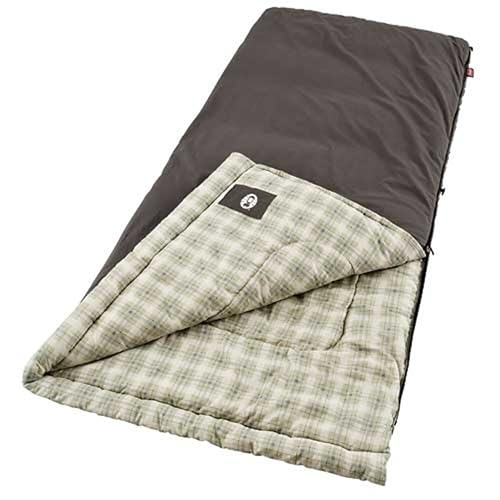

| Expected overnight low | Recommended bag rating | Example product |
|---|---|---|
| 60F | 50F | A lightweight 3-season bag |
| 50F | 40F | A standard 3-season bag |
| 40F | 30F | Coleman Brazos Sleeping Bag, rated 30F ($53.99) |
| 30F | 20F | A cool-weather 3-season bag |
| 20F | 10F | Coleman Heritage Big & Tall, rated 10F ($101.99) |
| 10F | 0F | A cold-weather winter bag |
| 0F | Negative 10F | A dedicated winter or expedition bag |
This 10F buffer accounts for the gap between a bag's stated rating and how warm an individual sleeper actually feels, since cold tolerance varies by person, and for real-world factors a lab rating cannot fully capture, like wind, ground insulation quality, and how well the sleeper is dressed inside the bag.
Why buy a bag rated colder than the actual expected low?
A bag's temperature rating represents a lab-tested limit under fairly controlled conditions, not a guarantee of comfort for every sleeper in every situation. Wind, ground insulation, humidity, and individual cold tolerance all push the real felt temperature colder than the rating alone suggests. Building in a 10F buffer is the standard way experienced campers avoid a cold night from a bag that is technically rated for the temperature but not comfortably so. Pair the bag with the right sleeping pad using the sleeping pad R-value calculator, since a warm bag on a poorly insulated pad still leaves you cold from underneath.
What is the difference between comfort and limit ratings in practice?
Comfort rating is the more conservative, generally warmer temperature at which most people sleep well without needing to bundle up further. Limit rating is a colder temperature at which sleep is still possible but requires curling up and may involve some discomfort. When a bag lists both numbers, planning around the comfort rating rather than the limit rating is the safer choice for car camping, where the goal is a good night's sleep, not just survival.
Does a single stated rating mean the same thing across brands?
Not reliably. Many budget and mid-range camping bags list one number without specifying whether it follows EN/ISO 23537 testing or an internal company standard, which makes cross-brand comparison harder. Treating any single stated rating as closer to a limit rating, and applying the 10F buffer rule regardless of brand, is the safest general approach when the testing method is not specified on the listing.
How does sleeping bag rating interact with pad R-value?
A bag only insulates the sleeper from the air around them; it does very little to stop heat loss straight down into the ground or a cot. That job belongs to the sleeping pad's R-value. A well-matched bag on a poorly insulated pad, or a great pad with the wrong bag for the temperature, both lead to a cold night for different reasons. See the full R-value breakdown on the sleeping pad R-value chart.
Keep planning
Frequently asked questions
What sleeping bag rating do I need for an overnight low of 30F?
Follow the 10F buffer rule and choose a bag rated around 20F for an expected low of 30F. This buffer accounts for individual cold tolerance and real-world factors like wind and ground insulation that a lab rating cannot fully capture.
What is the difference between an EN/ISO comfort rating and a limit rating?
Comfort rating is the warmer, more conservative temperature at which an average sleeper rests well through the night, while limit rating is the colder temperature at which sleep is still possible but may require curling up and some discomfort. Planning around the comfort rating is the safer choice for most car camping.
Can I trust a single temperature number on a budget sleeping bag?
Treat it cautiously, since many budget bags do not specify whether the rating follows independent EN/ISO 23537 testing or an internal company estimate. Applying the 10F buffer rule regardless of the stated testing method is the safer general approach.
Does a sleeping pad matter as much as the sleeping bag's rating?
Yes. A sleeping bag insulates against the surrounding air, but a poorly insulated pad or cot lets heat escape straight down into the ground, which a warm bag cannot fully compensate for. Match both the bag rating and the pad R-value to your expected overnight low.
Are kids' sleeping bags rated the same way as adult bags?
Ratings use the same general temperature scale, but a kids' bag rated to a specific temperature, like 45F, is generally meant for milder conditions and shorter, lighter-weight sleepers rather than serious cold-weather use. Check the specific rating and apply the same 10F buffer for planning purposes.
Get the car camping checklist
One printable page: the full packing checklist plus our three complete setups with current prices. No sales sequence.
Used only to send the list. You can also read every setup free on this site.Researched guidance, not professional advice. Figures are published specifications or clearly labelled conventions; check your own gear's manual and your campground's rules.