Sleeping pad R-value chart
| Overnight low | Recommended R-value | Typical pad type at this R-value |
|---|---|---|
| 50F and up | R 1.5 to 2 | Basic foam pad, or an insulated air pad on low settings |
| 40 to 49F | R 2.5 to 3 | Light self-inflating pad, or a foam pad doubled up |
| 32 to 39F | R 3.5 to 4 | Standard self-inflating pad |
| 20 to 31F | R 4.5 to 5 | Thicker self-inflating pad, or a mid-weight insulated air pad |
| 10 to 19F | R 5.5 to 6 | Heavy self-inflating pad, or a stacked foam plus air pad combo |
| Below 10F | R 6.5+ | Winter-rated pad, or two pads stacked since R-values add |
R-values are standardized under ASTM F3340, in place since 2020, so values are comparable across brands. R-values add when pads are stacked, for example a foam pad under an inflatable pad, which is the standard way to reach a higher combined R-value without buying a single expensive winter pad.
Gear that matches this chart


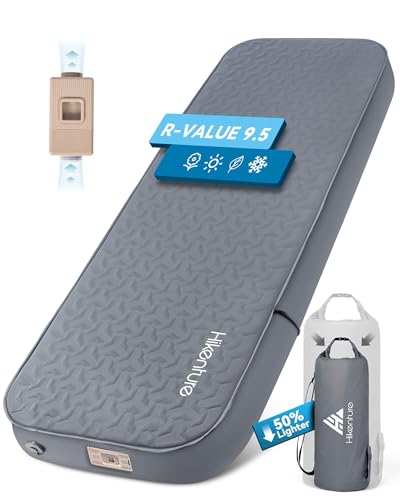
| Pad type | Typical R-value range | Example product | Price | Example R-value |
|---|---|---|---|---|
| Basic foam pad (closed-cell) | R 1 to 2 | Not in this catalog | ||
| Uninsulated air pad | R 1 or less | Not in this catalog | ||
| Light self-inflating pad | R 2 to 4 | LLUAII Self Inflating Sleeping Pad with Electric Pump | $70.99 | R 4 |
| Standard self-inflating pad | R 4 to 6 | TaskStar 4 in Self Inflating Sleeping Pad with Pillow | $49.99 | R 9.5 |
| Thick self-inflating pad | R 6 to 9.5+ | Hikenture 4 in Thick Self Inflating Pad with Electric Pump | $109.99 | R 9.5 |
R-value does not track price in a straight line. The TaskStar pad above carries an R 9.5 rating at a lower price than the Hikenture pad rated the same, since R-value depends on foam density and thickness, not brand positioning. Always check the specific R-value on the listing rather than assuming a higher price means warmer.
What does a sleeping pad's R-value actually measure?
R-value measures resistance to heat flow through the pad, specifically how well it blocks your body heat from transferring into the cold ground beneath your tent or cot. A higher R-value means less heat loss downward, which matters more for car camping comfort in cold weather than almost any other single piece of gear, since a warm sleeping bag on top of a poorly insulated pad still leaves you cold from underneath. Match your expected overnight low to the right R-value with the sleeping pad R-value calculator.
Do R-values really add up when I stack pads?
Yes, this is one of the more useful facts in the whole R-value system: placing a foam pad underneath an inflatable pad combines their R-values close to the sum of the two. A foam pad rated R 2 under an inflatable pad rated R 3 performs close to an R 5 setup. This is the standard budget-friendly way to reach winter-capable insulation without buying a single expensive high-R pad.
Why does a cot need extra R-value compared to ground sleeping?
A cot suspends you in moving air rather than against insulating ground or tent floor, and that airflow pulls heat away faster than still ground contact does. The rule of thumb is to add about R 1 to whatever pad you put on a cot compared to the R-value chart above, since the cot itself is actively working against your insulation rather than being neutral.
What happens if my pad's R-value is too low for the night?
You will feel cold from underneath even with a warm enough sleeping bag, since a bag's temperature rating assumes reasonable ground insulation and does not account for heat lost straight down through an under-insulated pad. This is the most common reason people report being cold camping despite bringing a bag rated well below the actual overnight low. See do you need a sleeping pad for the full explanation.
Keep planning
Frequently asked questions
What R-value sleeping pad do I need for camping in the 30s F?
For an overnight low in the low to mid 30s F, plan for a pad rated R 3.5 to 4. A standard self-inflating pad in that range handles most spring and fall car camping trips without needing to stack pads for extra warmth.
Can I stack two sleeping pads to reach a higher R-value?
Yes. R-values add when pads are stacked, so a foam pad under an inflatable pad, or two inflatable pads together, combines close to the sum of their individual R-values. This is a common and effective way to reach winter-level insulation without a single expensive high-R pad.
Is a higher R-value always better?
Not necessarily for warm-weather trips, since higher-R pads are usually thicker and sometimes warmer to sleep on than needed above roughly 50F. Match the pad to your coldest expected night rather than always buying the maximum R-value available.
Why does my air mattress feel cold even with a warm sleeping bag?
A standard uninsulated air mattress insulates poorly, around R 1 or less, and feels cold below roughly 50F regardless of how warm the sleeping bag on top of it is rated. The fix is adding an insulated pad or foam layer underneath the air mattress rather than upgrading the bag.
Does a cot need a higher R-value pad than sleeping on the ground?
Yes, add about R 1 to whatever the ground-sleeping chart recommends for your expected low. A cot suspends you in moving air underneath, which pulls heat away faster than solid ground or a tent floor does, so the same pad feels colder on a cot than it would on the ground.
Get the car camping checklist
One printable page: the full packing checklist plus our three complete setups with current prices. No sales sequence.
Used only to send the list. You can also read every setup free on this site.Researched guidance, not professional advice. Figures are published specifications or clearly labelled conventions; check your own gear's manual and your campground's rules.