Best sleeping pads for car camping
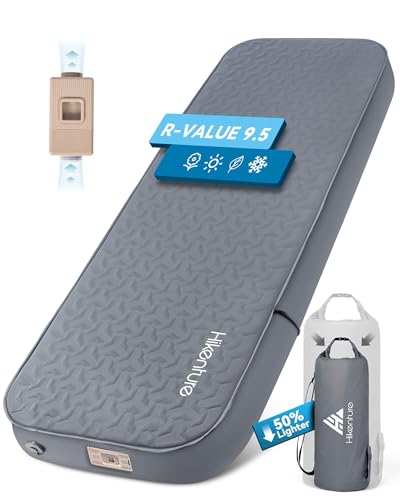
Hikenture 4" Thick Self Inflating Sleeping Pad with Electric Pump
$109.99The Hikenture 4-Inch Thick Self Inflating Sleeping Pad with Electric Pump combines a genuinely thick 4-inch foam-and-air core with an R9.5 insulation rating, high enough to cover most three-season overnight lows without stacking a second pad underneath. The built-in electric pump inflates and deflates it in under two minutes, which matters more for a car camping pad than for a backpacking one since weight is not the constraint, packing speed is.
Check price on AmazonSpecsNot sure what size you need? Run the What R-value do I need for my forecast low first, then come back to the picks.
Beginner, intermediate and expert picks
Beginner: Best first pad
For first-time car campers who want real thickness and insulation without an electric pump or a premium price.- Beginner pick
 TaskStar 4" Self Inflating Sleeping Pad for Camping with Pillow$49.99Check priceSpec sheet
The TaskStar 4-Inch Self Inflating Sleeping Pad with Pillow ($49.99) is rated R9.5, the same insulation ceiling as our top pick, in a 4-inch self-inflating pad with a built-in pillow, at well under half the price. It is a strong first pad for anyone who has not yet decided how often they will car camp.
Skip it if: Two people sharing one sleeping surface, since this is a single-width pad.
Intermediate: Buy once
For regular car campers who want the convenience of an electric pump on top of a thick, well-insulated pad.- Intermediate pickHikenture 4" Thick Self Inflating Sleeping Pad with Electric Pump$109.99Check priceSpec sheet
The Hikenture 4-Inch Thick Self Inflating Sleeping Pad with Electric Pump ($109.99) adds one-touch inflation and deflation to the same 4-inch, R9.5 formula, which is the upgrade most families actually notice after their first trip. Setting up and breaking camp is faster, and the pad packs down smaller than a manually inflated one.
Skip it if: Anyone sleeping two people who wants a single connected surface rather than two pads pushed together.
Expert: Performance ceiling
For couples who want a true MegaMat-style shared mattress and are willing to pay for it.- Expert pick
 Exped MegaMat Sleeping Pad$399.95Check priceSpec sheet
The Exped MegaMat Sleeping Pad, Duo Medium ($399.95) is a two-person, 4-inch foam-cored self-inflating mattress with a 3D vertical sidewall build that keeps both sleepers from rolling toward the center, the problem with pushing two single pads together. It is the closest a car camping pad gets to an actual mattress.
Skip it if: Solo campers, or anyone on a first trip who has not yet confirmed they will camp enough to justify a $400 sleeping pad.
| Product | Price | Key spec | Best for |
|---|---|---|---|
| TaskStar 4-Inch Self Inflating | $49.99 | R9.5, manual pump, pillow built in | Best first pad |
| Hikenture 4-Inch with Electric Pump | $109.99 | R9.5, electric pump | Most car campers |
| LLUAII 4-Inch with Electric Pump | $70.99 | R4, electric pump | Warm-weather budget option |
| Therm-a-Rest LuxuryMap Regular | $187.99 | R6.0, TwinLock valve | Premium single, cold-tolerant |
| Therm-a-Rest MondoKing 3D Large | $259.95 | R7.0, TwinLock valve | Cold-weather single sleeper |
| Exped MegaMat Ultra Medium Wide | $249.95 | 4-inch foam core | Wide single sleeper |
| Exped MegaMat Auto, wheel cutouts | $443.20 | 4-inch, shaped for cargo area | Sleeping inside the vehicle |
| Exped MegaMat Duo Medium | $399.95 | 4-inch foam core, two-person | Couples, buy-once mattress |
What R-value sleeping pad do I need for car camping?
R-value measures insulation against ground cold, and it is standardized across brands under the ASTM F3340 test, so an R9.5 pad from one brand insulates about the same as an R9.5 pad from another. As a rough guide: overnight lows of 50F or warmer need only R1.5 to 2, 40 to 49F needs R2.5 to 3, 32 to 39F needs R3.5 to 4, and anything colder than 20F needs R4.5 or more. The TaskStar and Hikenture pads in this roundup are both rated R9.5, which comfortably covers three-season camping down into the 10 to 19F range on paper, well past what most car campers will encounter.
Run your own expected overnight low through the sleeping pad R-value calculator, and see the sleeping pad R-value chart for the full table. R-values add when you stack pads, so a lower-rated pad under a higher one is a legitimate way to push warmth further on a cold trip rather than buying a second high-R pad.
Self-inflating pad or MegaMat-style mattress: what is the real difference?
Every pad in this roundup is self-inflating in the sense that opening a valve draws air in around a foam core, but there is a real gap between a 3 to 4 inch self-inflating pad built for one person, like the TaskStar or Hikenture, and a MegaMat-style mattress like the Exped MegaMat Duo. The MegaMat format uses a thicker foam core with a 3D vertical sidewall construction that stops sleepers from rolling into a valley in the middle, which is the main complaint with pushing two single pads side by side.
Not every product in the MegaMat family publishes an R-value in its current listing, so treat foam thickness, not a specific number, as the honest comparison point for those models: a 4-inch core insulates and cushions noticeably better than a 3-inch one regardless of brand.
Do you need a sleeping pad if you already have a cot or an air mattress?
A standard uninsulated air mattress feels cold once temperatures drop below roughly 50F, since it insulates poorly on its own at around R1 or less; adding a sleeping pad on top of an air mattress solves that by stacking R-values. A cot has the opposite problem: it loses heat to moving air underneath the sleeper, which effectively subtracts about R1 from whatever pad is on it, so a pad rated for your actual overnight low, not a slightly lower one, matters more on a cot than on the ground. See our full cot vs air mattress vs sleeping pad comparison and do you need a sleeping pad for more detail.
Sleeping in the car instead of a tent: does the pad need to be different?
Most self-inflating pads work fine laid flat across a folded-down seat or cargo area, but factory wheel wells and seat contours leave gaps that a standard rectangular pad does not fill. The Exped MegaMat Auto ($443.20) is shaped specifically with wheel-well cutouts for mid-size SUV and truck cargo areas, closing that gap without stacking blankets or extra padding around the edges. If you split nights between a tent and sleeping in the vehicle, see our car camping in an SUV guide for how the two setups differ beyond the pad itself.
- Flat cargo floor, no wheel wells in the sleeping area: any standard rectangular pad works
- Cargo area with visible wheel-well bumps: a shaped pad like the Exped MegaMat Auto closes the gap
- Splitting nights between tent and vehicle: a single 4-inch pad works in both, just confirm it fits the folded cargo length
How we chose
Every pick here comes from published thickness, R-value, and construction specs plus verified owner reviews on Amazon; nothing on this list was tested in person by us. Where a listing did not state an R-value, we described thickness and construction instead of estimating a number.
We favored pads with a clearly stated single width or a genuinely two-person design over listings that blur several sizes together, since fit against a specific tent floor or cargo area depends on knowing the real dimensions.
Buying tips
Is an electric pump worth paying more for?
For car camping, yes, more than for backpacking, since setup speed and convenience matter more than the small weight and cost savings of a manual pump.
Do thicker pads always mean warmer pads?
Not directly. Thickness mostly affects comfort and how much you feel the ground through pressure points; R-value is the number that specifically measures insulation.
Can I stack two pads for a colder trip?
Yes, R-values add when pads are stacked, so a lower-R foam pad under a higher-R inflatable is a legitimate way to boost warmth on an unusually cold trip.
Do these pads work as a guest bed at home between trips?
Most self-inflating car camping pads are marketed for exactly this dual use, since the thickness and foam core make them comfortable enough for occasional indoor use.
Also worth considering
 Therm-a-Rest LuxuryMap Self-Inflating Foam Camping Sleeping Pad$187.99Check priceSpec sheet
 Therm-a-Rest MondoKing 3D Self-Inflating Camping Sleeping Pad$259.95Check priceSpec sheet
 Exped MegaMat Ultra Sleeping Pad$249.95Check priceSpec sheet
 Exped MegaMat Auto Sleeping Pad with Wheel Cutouts$443.20Check priceSpec sheet
 LLUAII Self Inflating Sleeping Pad with Electric Pump$70.99Check priceSpec sheet
Keep planning
Frequently asked questions
What R-value sleeping pad do I need for car camping?
It depends on your coldest expected overnight low: R1.5 to 2 for 50F and warmer, R3.5 to 4 for 32 to 39F, and R4.5 or higher for anything colder. Both the TaskStar ($49.99) and Hikenture ($109.99) pads in this roundup are rated R9.5, which covers three-season camping with room to spare.
What is the difference between a self-inflating pad and a MegaMat?
Both use a foam core that draws in air through a valve, but a MegaMat-style pad like the Exped MegaMat Duo Medium ($399.95) uses a thicker core and a 3D sidewall build meant to sleep two people on one connected surface, while a standard self-inflating pad like the TaskStar ($49.99) is built for one sleeper.
Do I need a sleeping pad if I have an air mattress?
Usually yes in anything but warm weather. A standard uninsulated air mattress insulates poorly on its own, around R1 or less, and feels cold once nights drop below roughly 50F. Adding a sleeping pad underneath or in place of it solves that by adding real R-value.
Is a thick sleeping pad heavy to pack for car camping?
It is heavier than a backpacking pad, but weight is not the constraint in a car trunk the way it is on a trail. A 4-inch pad like the Hikenture ($109.99) packs down with its electric pump into a bag sized for a trunk, not a backpack.
What pad should I use if I am sleeping in the cargo area of an SUV instead of a tent?
Check for wheel-well bumps in your specific vehicle's cargo floor first. A flat cargo area works with any standard rectangular pad, while a cargo area with wheel-well contours fits better with a shaped pad like the Exped MegaMat Auto ($443.20), built with cutouts for exactly that layout.
Get the car camping checklist
One printable page: the full packing checklist plus our three complete setups with current prices. No sales sequence.
Used only to send the list. You can also read every setup free on this site.Researched guidance, not professional advice. Figures are published specifications or clearly labelled conventions; check your own gear's manual and your campground's rules.